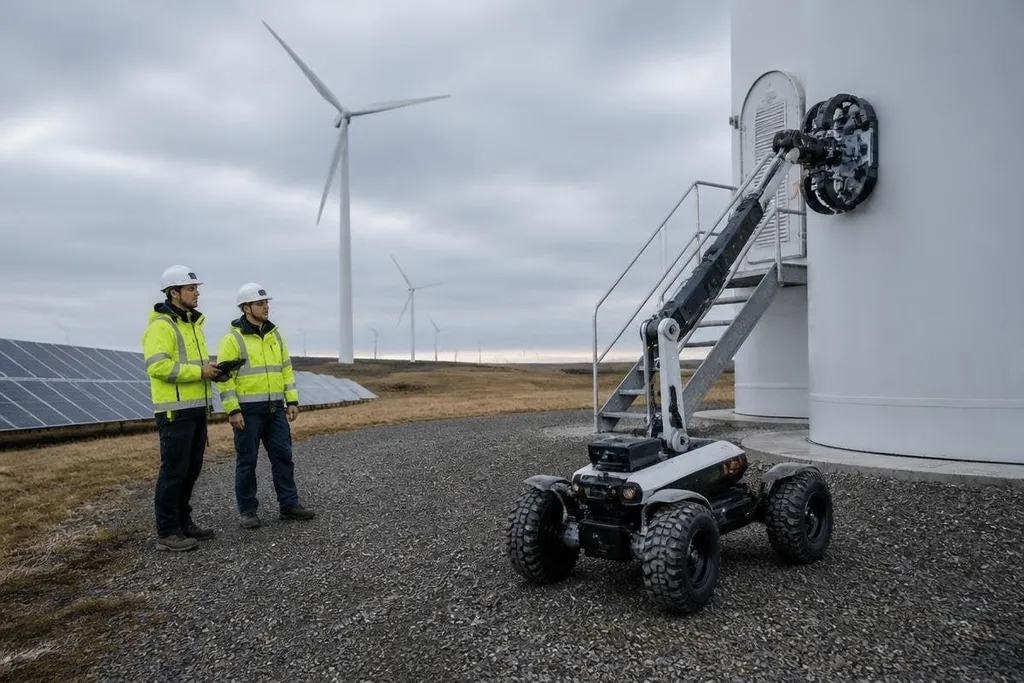
A wind turbine, solar field, or dam can sit far from a service road, exposed to heat, rain, ice, and strong winds. Robots could inspect these sites without sending a technician into every risky or difficult area, but repair work will take longer to prove.
Quick read
- Inspection robots can gather images, heat readings, and surface data.
- Repair machines need accurate movement, safe contact, and reliable power.
- Human technicians will still handle many jobs when parts, weather, or access defeat the robot.
Inspection comes first
A robot can move around a renewable power site with cameras, thermal sensors, or LiDAR. LiDAR measures distance with light, helping the system build a map of towers, panels, pipes, and nearby ground.
That map matters because maintenance starts with finding the fault. A drone could inspect a turbine blade from the air, while a ground robot could check cables, foundations, or drainage routes. A solar-field machine could look for panels that run hotter than nearby panels, which may point to an electrical fault.
The useful output is a repair decision. A camera image alone leaves a technician asking whether a mark is dirt, a crack, or a shadow. A good system would record the location, compare new readings with older ones, and send the technician to the part that needs attention.
Repair is a harder job
Inspection gives a robot some distance from the equipment. Repair puts the machine in contact with it, where a small error can damage a seal, cable, blade, or sensor.
A repair robot would need an arm with enough reach and force control to remove a cover, hold a part, or turn a fastener. It would also need to work around wind, vibration, water, and uneven ground. Those conditions change the task every time the robot arrives.
Teleoperation can cover some of the gap. In that setup, a person controls the robot from a safer location while cameras and force sensors send information back. The link still needs low delay, and the robot needs a safe state when communication drops.
This is why a machine that finds damage may reach the market before one that fixes it. The inspection task has a clearer path to useful data. Repair needs the robot, the tools, the spare parts, and the work area to line up.
Where the work will happen
Renewable sites give robots different jobs. Wind equipment places the work high above the ground. Solar fields spread the work over large areas. Hydropower plants put machines near water, confined spaces, and heavy mechanical equipment.
Each site changes the design. A flying robot may reach a blade quickly but carry little repair hardware. A tracked robot may carry more weight but need a clear route. A climbing machine can stay close to a tower or wall, though its grip must hold through weather and surface changes.
The business case also changes with access. A robot has a better reason to exist when a trip needs a boat, a lift, a road closure, or a long wait for safe weather.
If a technician can reach the fault in minutes with ordinary tools, a robot may add cost without removing much work.
A drone that checks turbine blades may cut a rope climb. The result depends on blade height, wind speed, camera range, and the repair decision. Renewable energy robotics reporting can place those facts beside the test, so you can see if the machine found a fault or produced another inspection video.
What still needs proof
Public demonstrations often show a short task in controlled conditions. Renewable maintenance needs repeatable work across changing sites, seasons, surfaces, and equipment types.
The open question is how much repair a robot can complete before a human has to take over. A system may inspect a blade in poor weather, then stop when it reaches a damaged fastener. That can still save a trip, but the savings depend on the full work order rather than the first successful scan.
I'd fund inspection robots before repair robots. The data from inspection can improve planning even when the machine cannot hold a tool, while a failed repair attempt can leave equipment in a worse state.
A buying checklist
Before funding a maintenance robot, check these points:
- Name the task: define the part, fault, and action the robot must handle.
- Measure access: record height, distance, surface type, weather limits, and travel time.
- Set the handoff: state when a technician takes control and what data they receive.
- Test repeat work: run the same task across more than one site and equipment condition.
- Price the whole job: include transport, supervision, software, tools, spare parts, and recovery after a fault.
A sensible first project will collect useful inspection data and reduce exposure to risky areas. Repair work can follow when trials prove that the robot finishes more of the job than it interrupts.